

Complete Tow Systems
Check Out Our Other Collections

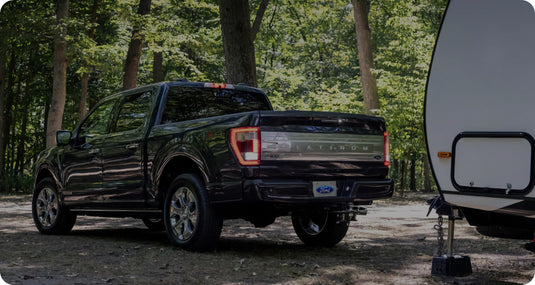
Complete Tow Systems
Complete Tow Systems – RV Trader Accessories Store
Flat towing - pulling a dinghy vehicle behind a motorhome with all four wheels on the ground - is the most practical way to bring a second vehicle on an extended RV trip. No trailer to store, no loading ramps, no tow dolly. You park the motorhome at the campsite and drive the dinghy to the trailhead, the grocery store, or wherever you're going.
Setting it up correctly requires a matched system of three components: a tow bar that connects to the motorhome's receiver hitch, a vehicle-specific baseplate that bolts to the dinghy's frame and provides the connection points for the tow bar, and a wiring harness that ties the dinghy's brake lights and turn signals to the motorhome's lighting circuit. Every complete tow system in this collection includes all three, factory-matched and vehicle-specific.
All 166 products in this collection are Blue Ox tow bar and baseplate combos - the most widely used flat towing brand on American highways. Every combo includes either the Avail (10,000 lb), Alpha (8,500 lb), or Apollo (12,500 lb) tow bar paired with a vehicle-specific baseplate, and most include a towed vehicle wiring kit. All products are in-stock and ready to ship.
Already have a motorhome and looking for your next dinghy? Browse Class A motorhomes and Class C motorhomes on RVTrader.com.
What Is Flat Towing?
Flat towing (also called dinghy towing or four-down towing) means the dinghy vehicle rolls behind the motorhome on its own wheels with no trailer or dolly between them. The tow bar connects the dinghy's front frame to the motorhome's rear receiver hitch, the dinghy's steering is unlocked, and the vehicle follows the motorhome's path while being towed.
The advantages over a car hauler trailer are significant: no trailer registration, no trailer backing, no ramp loading, and far less drag and sway behind the motorhome. The loaded combination handles more like a single long vehicle. When you reach your destination, you disconnect the tow bar in minutes and drive off in the dinghy.
Not every vehicle can be flat towed. The dinghy's drivetrain design determines compatibility - specifically, whether the transmission and transfer case can be safely towed with the engine off. Manual transmission vehicles and some 4WD vehicles with a neutral position in the transfer case are commonly flat-towable. Many automatic transmission vehicles require lubrication provided by the running engine and cannot be flat towed without a driveshaft disconnect or transmission pump. Check the dinghy vehicle's owner's manual under "Recreational Towing" or "Dinghy Towing" before purchasing a system.
The Three Blue Ox Tow Bar Models
Every combo in this collection pairs a Blue Ox tow bar with a vehicle-specific baseplate. Choosing the right tow bar comes down to the dinghy vehicle's weight and the baseplate's tab width - the physical span of the connection points on the baseplate that the tow bar arms must reach.
Blue Ox Avail - 10,000 lb Capacity, 2" Receiver
The most popular Blue Ox tow bar and the most common model in this collection. The Avail comes with safety cables and rubber boots on the arms to protect against dirt build-up, which means smooth, reliable arm extension every hookup. The Avail's longer arms accommodate wider baseplates - up to 38" tab width - making it the correct choice for full-size trucks, large SUVs, and any dinghy with a wide front frame. Rated to 10,000 lbs, it handles virtually any passenger vehicle a motorhome owner would flat tow, including loaded pickups.
Available in standard and 2.5" receiver versions for motorhomes with larger hitch openings. Most combo kits in this collection use the standard 2" version.
Blue Ox Alpha - 8,500 lb Capacity, 2" Receiver
The Alpha is Blue Ox's step-down model - slightly shorter arms, lower weight rating, and a more compact stored profile than the Avail. The biggest practical difference between the Alpha and Avail is tab width compatibility - the Alpha handles narrower baseplates, and choosing wrong means the tow bar won't connect properly. For compact SUVs, crossovers, Jeep Wranglers, and smaller vehicles where the baseplate tab width is within the Alpha's range, it's the right choice and carries the same Blue Ox build quality at a lower price point.
Alpha combos in this collection cover Jeep Wrangler JK and JL, Jeep Gladiator, Ford Bronco, Ford Ranger, Chevrolet Colorado, GMC Canyon, Honda CR-V, Honda Fit, Mini Cooper, Chevy Tahoe/Suburban (non-diesel), and others.
Blue Ox Apollo - 12,500 lb Capacity, 2.5" Receiver
The Apollo is designed for heavy-duty flat towing - full-sized trucks and SUVs where the 10,000 lb Avail rating may not provide adequate margin. It uses a 2.5" receiver and is the appropriate choice when towing a loaded full-size truck or heavy SUV behind a diesel pusher or larger motorhome. Apollo combos in this collection cover the GMC 2500/3500 platform.
What's Included in Each Combo Kit
Every combo kit in this collection bundles the tow bar and baseplate. Most also include a towed vehicle wiring kit - check the individual product listing for inclusions, as wiring kits are part of some configurations but not all. A complete flat towing setup requires:
Tow bar - The telescoping arm assembly that connects the dinghy to the motorhome's receiver. Included in every combo.
Baseplate - The vehicle-specific bracket that bolts to the dinghy's frame and provides the attachment points for the tow bar arms. Included in every combo. Blue Ox baseplates use as many attachment points as possible, feature removable tabs that leave a clean look when the vehicle is not being towed, require no welding, and are hidden beneath the vehicle body.
Towed vehicle wiring kit - Routes brake light and turn signal signals from the dinghy's tail lights to the motorhome's lighting circuit, so following traffic sees the brake lights and signals of the combination rather than just the motorhome. Included in most combo configurations in this collection - confirm on the product listing.
Safety cables - Required by law in most states and included with Blue Ox tow bars. Provide a backup connection if the tow bar disconnects during towing.
Supplemental braking system - Not included in these combos but legally required in most states and recommended for all flat towing setups. A complete flat towing setup includes a tow bar, vehicle-specific base plate, a supplemental braking system, safety cables, and a wiring kit to connect the RV's lighting system to the towed vehicle. Blue Ox's supplemental braking systems are available separately.
Choosing the Right Combo for Your Vehicle
Step 1 - Confirm your dinghy is flat towable. Check the owner's manual under "Recreational Towing." If it's not listed as flat towable, a tow dolly or car hauler trailer is required instead.
Step 2 - Find your vehicle in the fitment list. Every combo in this collection is vehicle-specific. Use the fitment filter to find kits confirmed for your dinghy's year, make, and model. Pay attention to trim and package exclusions - some kits specify bumper type (standard vs. off-road), presence of adaptive cruise control, or specific model variants. Getting the baseplate wrong means the tow bar arms won't align.
Step 3 - Match the tow bar to your motorhome's receiver. Most motorhomes use a standard 2" receiver - the Avail and Alpha both fit. The Apollo requires a 2.5" receiver, standard on larger diesel pushers with heavy-duty tow packages.
Step 4 - Verify your motorhome's tow rating. Since the motorhome will be doing the heavy work, it's essential to determine its tow rating. The motorhome's chassis manufacturer provides this figure - it's the ceiling regardless of which tow bar you install.
FAQ
What is flat towing a vehicle behind an RV? Flat towing (also called dinghy towing or four-down towing) means pulling a vehicle behind a motorhome with all four wheels on the road, connected by a tow bar and vehicle-specific baseplate. No trailer or dolly is used. When you arrive at a campsite, you disconnect the tow bar in minutes and drive the dinghy independently.
Can any vehicle be flat towed? No. The dinghy's drivetrain and transmission design determines whether it can be flat towed safely. Check the owner's manual under "Recreational Towing" - vehicles approved for flat towing by the manufacturer list the procedure there. Many automatic transmission vehicles cannot be flat towed without transmission damage unless a specific procedure is followed. Common flat-towable vehicles include Jeep Wranglers and Gladiators, Ford Broncos, most manual transmission vehicles, and many 4WD vehicles with a transfer case neutral position.
What is the difference between the Blue Ox Avail and Alpha tow bar? The Avail is rated to 10,000 lbs with longer arms that accommodate baseplates up to 38" tab width - appropriate for full-size trucks and larger SUVs. The Alpha is rated to 8,500 lbs with a shorter arm design for narrower baseplates on compact and mid-size vehicles. Both use a 2" receiver and share the same Blue Ox baseplate mounting system - they're interchangeable with the same baseplate if you upgrade later.
What is a tow bar baseplate? A baseplate is a vehicle-specific bracket that bolts to the dinghy vehicle's frame without drilling or welding, providing the attachment points for the tow bar arms. Each baseplate is engineered for a specific vehicle's frame geometry. Blue Ox baseplates include removable tabs so the connection points are hidden when the vehicle isn't being towed, leaving a clean front appearance.
Do I need a supplemental braking system for flat towing? Most states require a supplemental braking system when flat towing, and it's the right practice regardless of local law. When only the motorhome's brakes are stopping the combined weight of both vehicles, stopping distance increases and premature brake wear is the result. A supplemental braking system activates the dinghy's brakes proportionally when the motorhome brakes, distributing the stopping load across both vehicles.
Can I back up with a flat towed vehicle? No. Tow bars are designed to handle load in one direction only - forward towing. Attempting to reverse with a dinghy attached will damage the tow bar and potentially the dinghy's steering. Always disconnect the tow bar before reversing into a campsite.
Does flat towing void a vehicle's warranty? If the owner's manual states the vehicle is flat towable and the manufacturer's procedure is followed, it will not void the warranty. Flat towing a vehicle not approved for it, or not following the required procedure (such as setting the transfer case to neutral), can cause drivetrain damage that may not be covered.
Ready to set up your dinghy towing system? Browse the full Complete Tow Systems collection above and use the fitment filter for your dinghy vehicle's year, make, and model. For the motorhome receiver hitch side of the setup, the receiver hitches collection has vehicle-specific hitches if your motorhome doesn't already have one. For more on the flat towing process before you buy, RVTrader's guide to buying a Class A RV and what to know before selecting a Class C motorhome cover the motorhome side of the equation.
Shopping for the motorhome to tow from? Browse Class A motorhomes and Class C motorhomes on RVTrader.com.
